Showing posts with label AB InBev and Corona. Show all posts

Saturday, 10 November 2012

INBEV CARLS BRITO


The man who would be King of Beers is a no-frills leader without a company car or even his own desk.
Carlos Brito:
 chief executive of brewer InBev SA, says he doesn't care for perks — and neither should the people who work for him.
"I don't want the company to give me free beer; I can buy my own beer," he told Stanford MBA students earlier this year.
Brito, who will be leading Anheuser-Busch after the company agreed to InBev's $52 billion takeover offer, has been described as "an American-style" manager who is fiercely private and admits himself that he did not always get "the people thing," when he started off in sales.
Anheuser-Busch is a perked-up company with corporate jets for executives and free beer for the workers — as well as generous donations to local communities and politicians. Similar employee extras at Belgium's Interbrew vanished when it merged with Brito's Brazil-based AmBev in 2004.
"His reputation precedes him as a no-frills, no-thrills severe cost-cutter," says Eric Shepard, editor of beer industry newsletter Beer Marketer's Insights.
Brito rarely grants interviews and is reticent with the press, sticking to a few standard lines when he must face the camera for InBev's annual results or shareholders' meetings. The company refused to even confirm whether he was married with four children, saying "We don't give details on his private life."
Alberto Cerqueira Lima, a former colleague of Brito's at Brazilian brewer Brahma and now head of a Massachusetts-based market research firm, says "if he could, he would remain anonymous," describing Brito as a "workaholic and a methodical and pragmatic executive."
He showed himself to be a careful businessman who kept his cool during a difficult monthlong courtship of Anheuser-Busch when both companies threatened to start a hostile battle.
"He says the right things," says Shepard. "He knew the kind of backlash that he was going to get and I don't think he ever betrayed any sort of hostility even as they were making hostile moves.
"Publicly, he maintained that he wanted a friendly combination and ultimately that's what he got," he said.
The new company will create the world's largest beer company, turning out major brands such as Budweiser and Stella Artois. InBev's focus on carving costs made it the world's most profitable brewer, wringing profit from stagnant markets and winning admiration from shareholders and the rest of the industry — but angering workers.
"It's quite an American style compared to the Western European standard," said Kris Kippers, an analyst at Belgian investment firm Petercam. "He's really an American-style manager; those who deliver, who do good work, are rewarded."
Born in 1960, Brito studied mechanical engineering in Rio de Janeiro and applied to several U.S. universities for a master's in business administration. He was accepted by several — but could not pay his way.
A family friend put him in touch with Brazilian investment banker and billionaire Jorge Paulo Lemann, who told Brito he would pay for his graduate studies at Stanford.
"All he wanted in return were periodic reports and clippings from the United States to keep him up to date with what was going on there," said Cerqueira Lima. "Brito insisted on knowing how he would pay Lemann back and Lemann said, 'I do not want to be paid back. One day you will do for others what I am doing for you.'"
Lemann put Brito to work at Brahma when he bought it in 1989, later merging it with another beer company, Antarctica, to form AmBev.
Brito acknowledges that he didn't always get "the people thing," when he started off in sales, seeing that as the only truly important part of a business.
He first saw a promotion from head of sales to head of operations — in charge of workers and manufacturing — as a step down. But he says he surprised himself by enjoying managing people and coming to understand how they were at the heart of the business.
Brito had been head of InBev's North American business for just over a year when he became CEO in August 2005, as the Brazilian management team firmly took the reins of the company and rolled out zero-based budgeting that forces managers to justify every expense.
He doesn't have his own personal assistant or company car and shares a desk with top finance, marketing and human resources executives in an open office that he says allows dozens of two-minute meetings to discuss the business throughout the day. Hiding behind an office door is for the mediocre, he claims.
Brito admits that InBev's Spartan style can make it difficult to attract experienced staff because few enjoy its "more risk, more reward-type environment."
"It is very hard to find people that will be excited about the way we are trying to build the business, but once you find them they get really connected to the company, they cannot work anywhere else because they love this kind of openness and candor," he told the Stanford students.
InBev prefers to hire young graduates and promote from within on merit instead of seniority. Brito says he believes it is important to focus on the 250 people — out of 85,000 workers — who make a difference to the company.
"These people, they are managed in a different way, because we want to make sure they are excited, they're not going to leave the company," he said at Stanford. "We've got to make sure these people are engaged and getting everything they have to grow our business."
Talented people want to work for successful companies that are growing and generating new career opportunities, he says: "You want to build something that's better than you."

Read more...

Wednesday, 31 October 2012

INBEV TAKEOVER MODELO GROUP BRANDS

INBEV TAKEOVER MODELO GROUP BRANDS:


Barrilito:

Barrilito is a lager beer made with high quality ingredients. Because of its transparent and bright gold color, good body, clean aroma and refreshing flavor, it is an excellent pilsner beer.

Barrilito is Grupo Modelo's fourth most popular brand in Mexico. In 2010 we launched the new 444 milliliter bottle to respond to the needs of consumers looking for this brand in a larger size.


Corona Extra:

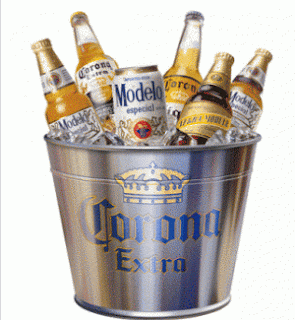
Corona Extra is the leading brand in Mexico, the number one imported beer in the US, the fourth most valuable brand in the world and the most popular Mexican beer worldwide. It is a pilsner beer. The Corona Extra brand is targeted to people who are looking to relax responsibly. It is the only brand that stands for Mexican pride all over the world. It is currently sold in more than 170 countries in five continents and it is the leading import beer in almost fifty of such countries.

Corona Extra was first produced in 1925 at the Cervecería Modelo in Mexico City.

Corona Light:


Corona Light was the first light lager beer produced by Grupo Modelo. Only Corona Light takes you away from your everyday stress, making you feel light, without remorse.

Corona Light is the fifth most popular imported beer in the US, and the number one imported light beer.

Corona Light was introduced in the United States in 1989 and in Mexico in 2007. It contains approximately 30% less calories than Corona Extra.

Corona Light was the first light lager beer produced by Grupo Modelo. Only Corona Light takes you away from your everyday stress, making you feel light, without remorse.

Corona Light is the fifth most popular imported beer in the US, and the number one imported light beer.

Corona Light was introduced in the United States in 1989 and in Mexico in 2007. It contains approximately 30% less calories than Corona Extra.

Estrella:


Estrella is known as the perfect addition to any party. It is a pilsner beer produced in the Guadalajara Modelo plant. Because of its light and friendly taste, it enhances the atmosphere of any social gathering. Estrella communicates the "feel the energy" message.

Estrella was first produced in the late 19th Century by Cervecería Estrella (currently known as Cervecería Modelo de Guadalajara), that Grupo Modelo acquired in 1954.

León:


León is a Munich-type dark amber-colored beer, with great aroma and body, that mixes a nice sweetness with light bitterness, and a white foam.

León has become a new favorite of young people who are looking for a dark beer with a great taste.

The León brand was first launched into the market in the early 1900s. Although its origin is traced back to the southeast region of Mexico, through the years it has conquered the tastes of consumers in the entire country.

León is a Munich-type dark amber-colored beer, with great aroma and body, that mixes a nice sweetness with light bitterness, and a white foam.


León has become a new favorite of young people who are looking for a dark beer with a great taste.

The León brand was first launched into the market in the early 1900s. Although its origin is traced back to the southeast region of Mexico, through the years it has conquered the tastes of consumers in the entire country.

Modelo Especial:


Modelo Especial is Grupo Modelo's second most popular beer—and the most popular canned beer—as well as the third most popular imported brand in the US. It is a very different, pilsner beer, full of attitude and image.

In 2010 we changed its image. Essentially, we added the date of its creation, 1925, on the Modelo Especial label, we redesigned the legendary lions and we changed the style on the word "Especial". The new image of Modelo Especial reflects the strength of the lion, a symbol of Grupo Modelo, and the pride behind its great quality. It also recognizes its 85 year history, and a tradition of great flavor and body.

Modelo Especial was the first brand produced by Grupo Modelo, in 1925, the year in which the company was founded.

Modelo Light:

Modelo Light is "a beer like you never imagined". It's an innovative light lager alternative for people who seek the new and avoid the conventional.

Modelo Light is sold in its stylish signature blue bottle and in can.

Modelo Light was first produced in 1994.

Montejo:

Montejo, the brand that originated in the city of Merida, in the Yucatán peninsula, is a pilsner characterized by its smooth flavor and excellent aroma.

It is a regional brand, whose tradition began in southeastern Mexico when it was launched in 1960 as an anniversary brand for Cervecería Yucateca.

It was purchased by Grupo Modelo in 1979, and in 1999 it updated the brand's look and feel to give it a fresh and current image.


Negra Modelo:

Negra Modelo, known as the "the cream of beers", is a Munich-style beer offering a balanced flavor and delicate aroma of dark malt, caramel and hops.

It is the top selling dark beer in Mexico. It has a bright, dark amber color, topped by a thick, creamy foam. Because of its unique flavor, Negra Modelo is the ideal beer to accompany any special occasion.

It was first introduced in Mexico in 1925 as a dark beer under the name Modelo, this beginning its great tradition in Mexico.

Pacífico:

Pacífico is a beer with a long tradition in Mexico and is Grupo Modelo's leading brand in northeastern Mexico. It is a pilsner, clear beer with a refreshing, smooth taste. Pacífico was first brewed in Mazatlán, Mexico and Grupo Modelo began exporting it to the western and southern US in 1985, with great results. Pacífico is currently the fifteenth most popular imported brand in the US.

Pacífico is the best choice for people who like to share with their friends, enjoying what has come to be known as the "Pacífico lifestyle".

Pacífico was born in the early 20th Century and it is brewed mainly in the Cervecería del Pacífico plant, in the city of Mazatlán, in the state of Sinaloa.


Pacífico Light:

Pacífico Light is a new option for people who enjoy and prefer the tradition of our Pacífico beer and are looking for a lighter flavor.

Pacífico Light was launched in 2008 and is currently available in Northeastern and Northwestern Mexico. With this brand Modelo offers a very high quality product, with less than 100 calories, less alcohol content and great flavor.

Pacífico Light is Grupo Modelo's response to the consumer who wants to continue to be authentic, to feel lighter and to enjoy a refreshing beer.

Tropical Light:

Tropical Light was born out of the need to satisfy consumers looking for a good light beer with low alcohol content.

It is a pilsner golden-colored beer with 3% volume of alcohol and an adequate balance between body and bitterness, which makes it easy to digest.

Tropical Light was born in 2007.

Victoria:

Victoria—the brand that most reflects the Mexican tradition of Grupo Modelo—is a Vienna-style beer whose roots are closely linked to the history of Mexico. Victoria has the delicate aroma of the highest quality malt and hops, that is well-balanced with its unique amber-color and its bright and refreshing creamy foam that tops its transparent and bright appearance. With its more than one-hundred years of history, Victoria continues to be the brand that, because of its exact taste, pleases everyone.

Victoria was originally produced by the Compañía Cervecera de Toluca y México that was acquired by Grupo Modelo in 1935. Exports of Victoria to the US began in 2010.

Source:http://www.gmodelo.mx/pacifico_light_en.jsp


Read more...

Wednesday, 19 September 2012

Anheuser-Busch InBev Closed Buying Corona-Maker- Modelo Group:

Anheuser-Busch InBev Closed Buying Corona-Maker- Modelo Group:


1.AB InBev deal for Modelo could be worth up to $15 billion

2.Price is main sticking point

3.Mexico a growing beer market

4.Deal would give AB InBev control of Corona US imports

5.AB InBev shares up 2.8 pct, among strongest in Europe.

By Philip Blenkinsop and David Jones,.

BRUSSELS/LONDON, June 25 (Reuters) - 

1.Mexico's growing beer market, big cost savings and control of Corona beer exports have attracted Anheuser-Busch InBev towards a $15 billion buy out of Grupo Modelo, sources said on Monday.

2.The deal would give AB InBev, the world's largest brewer access to 2-3 percent annual growth in the Mexican market, make at least $250 million of synergies and win distribution rights to Corona, the largest U.S. imported beer brand.

3.The brewer of Budweiser and Stella Artois already owns a 50.4 percent stake in Modelo and is currently in talks to buy the rest from the Modelo controlling families, who have 56 percent of the shareholder voting power, the sources added.

4.Mexico is the world's sixth biggest beer market and the fourth most profitable and is a virtual duopoly between Modelo and Heineken. Analysts say it would be a good strategic deal for AB InBev.

5."We believe a take-out price would be closer to $15 billion, equating to a 30 percent control premium in line with historic average brewing premiums," said analysts at Citi.

6.Analyst Pablo Zuanic at brokers Liberum Capital says Modelo shares currently trade on 10.7 times core profit, or EBITDA, and he would expect a deal at 13-15 times with the mid-point giving a value for the half stake in Modelo at $14.8 billion.

7.Modelo has a 50-percent-plus market share of the Mexican beer market, but a relatively low profit margin of around 26 percent which AB InBev would look to push towards the margin of 60-65 percent it earns in Brazil.

8.AB InBev declined to comment on a possible deal, while Modelo spokeswoman Jennifer Shelley said the company does not comment on rumour or speculation.

9.Banking sources said the two sides were in close talks but the sticking point was the size of the premium the Modelo families can extract from AB InBev.

10"The families are willing to sell but they want a big price as they see a big boost for AB InBev from owning 100 percent of Modelo," said one banker close to the talks.

AB Inbev Focus:

1.The move would increase AB InBev's focus on North and Latin America which already accounts for over 90 percent of profits with its half share of the U.S. market and 70 percent of Brazil.

2.AB InBev inherited its stake in Modelo when InBev bought Anheuser-Busch in 2008 for $52 billion, and after sharply cutting debt and reported free cash flow of $9.1 billion in 2011, the group has scope to finance a possible deal in cash.

3.It would be the latest in a series of changes in the global brewing industry as companies seek growth in emerging markets and look to make big savings in procurement and distribution.

4.In April, AB InBev agreed to buy Dominican Republic's Cerveceria Nacional Dominicana for more than $1.2 billion, while in the same month Molson Coors bought East European brewer StarBev for 2.65 billion euros ($3.5 billion), and last year SABMiller purchased Foster's for $11.8 billion.

5.A deal between Mexico City-based Modelo and AB InBev could finally end what has been a rocky relationship since 2008, when Modelo launched an arbitration case claiming it was not consulted about InBev's acquisition of Anheuser-Busch.

6.The way was cleared for AB InBev to increase its Modelo stake when the Mexican brewer lost the case in 2010, but Modelo Chief Executive Carlos Fernandez said controlling shareholders would not sell their stake.

7.Analysts said AB InBev taking on the import rights for Corona beer in the U.S. could cause anti-trust problems in the U.S. because of its high market share, but said it could get around this by selling off some of its smaller beer brands.

8.Corona is currently imported into the U.S. through a joint venture with Constellation Brands in an agreement which runs until 2016, and if AB InBev wanted to break this deal early then it would have to pay Constellation compensation.

9.AB InBev stock, up 43 percent over the last year, was 2.8 percent higher at 57.19 euros at 1315 GMT, making it among the strongest in the FTSEurofirst 300 index of leading European shares.

10.Modelo shares rose 9.6 percent in early trading, after having risen 41 percent in the past 12 months.

11."The logic is that they take control . Then they get to push through the cost savings plans that they've carried out in the rest of the world," said analyst Gerard Rijk at brokers ING.


Read more...

Sunday, 22 July 2012

AB InBev and Corona maker Modelo take over for $20.1bn

AB InBev and Corona maker Modelo take over for $20.1bn : The world's biggest brewer, Anheuser-Busch InBev, has widened the gap on its rivals after swallowing the maker of Corona, Grupo Modelo, for $20.1bn (£12.9bn).
Abinbev and corona maker take over for 20.1 bn
Budweiser-owner AB InBev has bought the 50pc stake in Mexico's Grupo Modelo it didn't already own.

Comment: 
The deal is the second biggest global merger or acquisition announced so far this year, behind the proposed $60bn tie-up between commodity giant Glencore and miner Xstrata.

It also follows a string of deals by major drinks companies in fast-growth emerging markets over the last few years.

InBev is buying the remaining 50pc stake it doesn’t already own in Modelo, which is the world’s seventh biggest beer company and the market leader in Mexico ahead of Heineken.

It is estimated the combined group would produced about 400m hectolitres of beer annually and would reach sales of about $47bn - opening a chasm between InBev and its nearest rival SABMiller, whose total beverage production, including soft drinks, hit 286m hectolitres last year.

The agreed price of $9.15 a share represents a 30pc premium to Modelo’s share price on 22 June, surprising some analysts.

Previously the cost of a full takeover had been estimated at about $12bn and concerns over the final price tag put some pressure on InBev’s shares in early trading in Belgium.

Gerard Rijk, analyst with ING, said the agreed price was “disappointing”.

“The deal is at the high end of the expected price range,” he added in a note.

InBev, the owner of Budweiser, Beck’s and Stella Artois, has previously been linked to a potential takeover of FTSE heavyweight SABMiller in a bid to gain access to burgeoning beer markets in Africa.

Mexico’s beer market is the seventh most lucrative in the world and growth is estimated at about 3pc a year. The market is dominated by a duopoly between Modelo and Heineken which bought Mexico’s second biggest brewer, Femsa, in 2010.

InBev inherited its existing stake in 87-year-old Modelo in 2008 when it splashed $58bn on Anheuser-Busch.

The two companies had a strained relationship for several years after the founding families that controlled Modelo sought to block its inclusion in the takeover of Anheuser-Busch with InBev.
InBev said on Friday that it expected the deal to result in $600m of synergies, higher than the $250m mooted by analysts.

“There is tremendous opportunity from combining two leading brand portfolios and further expanding Grupo Modelo’s brands worldwide through AB InBev’s extensive global distribution network,” said Carlos Brito, chief executive of AB InBev.

The prospect of a full takeover of Modelo, which distributes its brands in the US through a joint venture with Constellation, had raised some concerns over competition. Coroner Extra is the biggest imported beer in the US, where InBev already dominates almost half of the market.

But Modelo said it had agreed to sell its 50pc stake in the JV, Crown Imports, to Constellation for $1.85bn. Constellation will continue to distribute Modelo’s brands in the America.

The Modelo deal, which is InBev’s biggest purchase since its 2008 takeover of Anheuser-Busch, follows a number of other deals by major brewers as they look to consolidate market share in fast growth emerging markets.

In the last 12 months, InBev has bought the Dominican Republic’s Cerveceria Nacional Dominicana for more than $1.2bn, Molson Coors snapped up Eastern European brewer StarBev for $2.65bn while SABMiller swooped on Foster’s in Australia for $11.8bn.

InBev was advised on the Modelo deal by Lazard.


Source:http://www.telegraph.co.uk

Read more...

Anheuser-Busch InBev grabs Modelo group Corona

Anheuser-Busch InBev grabs Modelo group Corona :
Anheuser Busch InBev Grabs Modelo group Corona

Mexico's largest brewer Grupo Modelo, which Anheuser-Busch Cos. once eyed as a possible savior in its failed attempt to thwart InBev's takeover, is being acquired by that same Belgian company for $20.1 billion.

The deal, announced early Friday morning, adds Corona to Anheuser-Busch InBev's trio of global flagship brands, which includes Budweiser, Stella Artois and Beck's.
And A-B InBev, already the world's largest brewer, gets even bigger. Once the deal closes, the company will be larger than its two largest competitors, SABMiller and Heineken, combined.

The Belgian brewer currently owns a 50 percent stake in Modelo that it acquired when the Belgian company took over Anheuser-Busch in 2008. Under the deal, it will buy the remaining stake at a purchase price of $9.15 per Modelo share.

Buying Modelo adds three "billion-dollar-brands" – Corona Extra, Modelo Especial and Victoria – to A-B InBev's current portfolio of 14 billion-dollar-brands.
Corona already is a global brand, holding the number one import ranking in 38 countries.

Yet Corona can grow even faster under its new owner, according to A-B InBev CEO Carlos Brito.

A-B InBev plans to pursue the same aggressive growth strategy for Corona as it has with Budweiser. Bud's sales volume outside the U.S. has grown 45 percent since 2009.

"We want to keep that (Corona's sales) momentum going,” Brito said during a Friday conference call with analysts. “We see a big opportunity to expand the Corona brand on a global basis as we did with global Budweiser the last three years.”

Using A-B InBev's marketing and distribution channels, Corona will increase its market share in growing Latin American countries and beyond, said Bill Finnie, a former A-B executive and an adjunct professor of strategy at the Olin Business School at Washington University in St. Louis.

There's a drinkability to Corona that is very consistent with the movement to lighter tasting beers in the U.S. and internationally,” Finnie said. “Corona could eventually be the dominant InBev brand in Central and South America and possibly, internationally.”

While Modelo is extremely profitable, analysts expect margins to grow even fatter under A-B InBev's renown cost-cutting discipline.

A-B InBev said it expects the combination to yield annual cost-savings of at least $600 million through combined purchasing opportunities, sharing best practices and efficiencies in overhead and systems costs.

“We have long been impressed with (A-B InBev) management's ability to acquire and integrate beer brands into its portfolio, generate synergies from merging best practices, and cut costs to the bone to drive margin growth,” Morningstar analyst Dave Sekera wrote Friday in a note. “We expect this time will be no different.”
Investors also showed their confidence, sending A-B InBev's share price up 8 percent to $79.65.

Under the terms of the deal, the Mexican brewer will take a series of steps to “simplify Grupo Modelo’s corporate structure,” then A-B InBev will tender an all-cash offer for the remaining shares. Modelo has interlocking subsidiaries that were created to keep control in the hands of the Mexican families that own the brewer.
The deal is expected to close in the first quarter of 2013, pending regulatory approvals in the U.S. and other countries.

The Modelo acquisition is the largest beer deal since 2008, when InBev acquired St. Louis-based Anheuser-Busch for $52 billion. To finance the Modelo acquisition, A-B InBev will borrow $14 billion.

Unlike InBev’s takeover of Anheuser-Busch, this deal will allow Modelo to maintain the trappings of independence. Modelo’s headquarters will remain in Mexico City and the Mexican company will maintain a local board of directors.

It also was unclear how Modelo would fit into the structure of A-B InBev's North American operations, which is based in St. Louis. The brewer didn't respond to questions on this matter.

One thing is familiar. The top person will leave. The Modelo CEO told Bloomberg News later Friday that he would be stepping down as head of the Mexican brewer after the deal is completed.

Still, Fernandez will have a seat on the local board of the acquired company, along with Grupo Modelo board members María Asunción Aramburuzabala and Valentín Díez Morodo.

Under the deal, two Modelo board members will join its board after investing $1.5 billion from the proceeds of the tender offer back into A-B InBev shares.
Though the prospective board members were unnamed in the press release, Bloomberg reported that Aramburuzabala and Díez Morodo would be appointed to the A-B InBev’s board.

To quell anti-trust concerns, Grupo Modelo will sell its 50 percent stake in Chicago-based Crown Imports, the joint venture that exports and markets its Corona brands in the U.S., to partner Constellation Brands, which is based in Victor, N.Y., for $1.85 billion.

By giving up control of Corona's distribution in the U.S., Modelo hopes the Crown divestiture will head off any antitrust concerns about the A-B InBev acquisition.
Some analysts had speculated A-B InBev might have to shed some brands to ease regulators' concerns, but Brito said no divestitures are planned.

An A-B InBev/Modelo combination would give the brewer a market share of about 53 percent in the U.S., and antitrust regulators could block or impose conditions on the deal.

“I think by selling the 50 percent stake in Crown to Constellation, clearly, they wanted to err on the side of safety in getting the deal approved by antitrust regulators,” said Harry Schuhmacher, editor of Beer Business Daily, an industry newsletter based in San Antonio.

Crown will manage marketing, distribution and pricing decisions of Grupo Modelo brands sold in the U.S. And customers likely won't be affected by the sale, said Kim Barrow, president and chief operating officer of Earth City-based Summit Distributing, Missouri's largest imported beer distributor.

We don't expect any changes in the way we do business,” Barrow said. “It should be business as usual.”

A-B InBev does have the right to exercise an option to acquire Crown every 10 years. But that provision may not survive regulators' scrutiny.
That might be a bargaining chip they put in there to have something to give up” if regulators raise concerns, Schuhmacher said.

Friday's acquisition announcement ends a close, but tumultuous relationship between the two brewers. The partnership first started in 1993 when A-B bought a share of Modelo as part of a bid to expand in Mexico. By the late 1990s, A-B owned a 50 percent interest in the business, and controlled nine of 19 board seats, while Modelo CEO Carlos Fernandez sat on the St. Louis brewer's board.

When InBev launched its takeover bid in 2008, A-B executives saw buying the rest of Modelo as their best option to remain independent - the so-called “Mexican defense” - and the two companies were near a deal in which A-B would buy out Modelo and potentially install Fernandez as CEO, according to an account in Dethroning the King, a 2011 book on the InBev takeover.

But that deal fell through, and Fernandez quit the board of A-B shortly before the deal with InBev.

Since then, relations between Modelo and A-B InBev have been frosty.

In 2008, Modelo filed for arbitration against A-B selling its stake in the Mexican brewer to InBev; arbitrators ruled in A-B's favor. Meanwhile Modelo has snubbed A-B InBev's network for several overseas distribution deals, instead picking rivals MolsonCoors and Carlsberg.

As a company closely controlled by various Mexican families, it was unclear why the owners decided to yield to A-B InBev.

Benj Steinman, editor of Beer Marketer's Insights, a New York-based trade newsletter, said Grupo Modelo had signaled recently that it wasn't interested in a sale.

“It could just be the timing for some of their shareholders
,” he said. “There is a sense of inevitability to it, in that you have an partner with extremely deep pockets.”

Source: http://www.stltoday.com/

Read more...

About This Blog

  © Blogger templates Newspaper III by Ourblogtemplates.com 2008

Back to TOP